.svg)
.svg)
.svg)

.svg)



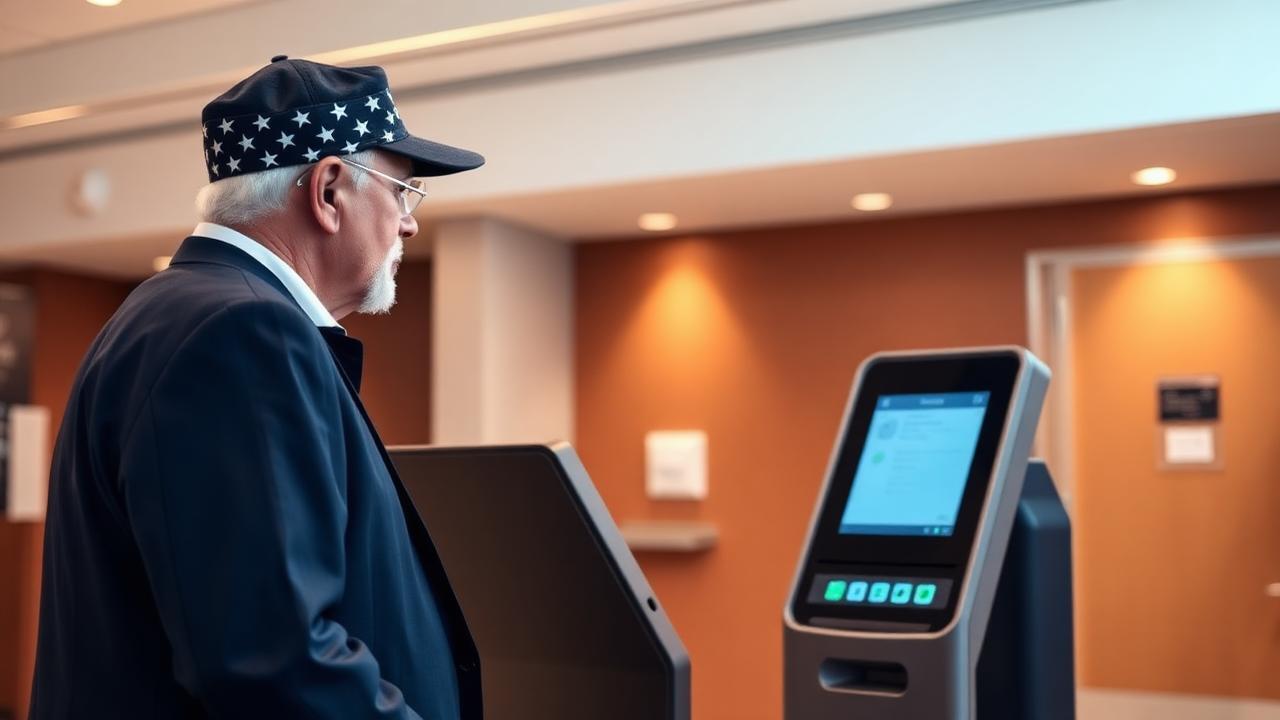
Veterans Healthcare Is Entering a New Operational Era
Across the U.S. healthcare system, veterans healthcare is undergoing one of the largest operational transformations in its history. Electronic health record modernization, expanded community-based care, increasing patient expectations, and growing demand variability are reshaping how care is delivered across ambulatory environments.
But beneath the technology modernization effort lies another challenge that receives far less attention: the frontline workforce experience.
As healthcare systems become more operationally complex, many of the pressures experienced by patients are also being absorbed by staff. Fragmented workflows, inconsistent intake processes, manual queue handling, and limited operational visibility are not only affecting patient flow, they are reshaping how frontline teams work every day.
This is particularly relevant in veterans healthcare environments, where staff must navigate high patient volumes, diverse care settings, workforce constraints, and rising expectations for access and experience simultaneously.
The Operational Burden Is Shifting to the Frontline
For decades, healthcare operations have been built around scheduling-centric models designed to create predictability and structure. But across high-volume ambulatory services such as laboratories, radiology, pharmacies, and primary care access points, that model is becoming increasingly misaligned with operational reality.
Healthcare organizations are now managing:
- More walk-in driven demand
- Greater variability in patient arrivals
- Hybrid appointment models
- Increased administrative coordination
- Growing cross-channel complexity
The result is that frontline staff are often forced to compensate for operational fragmentation manually.
In practice, this means employees spend increasing amounts of time on:
- Repetitive patient questions
- Manual intake coordination
- Queue management
- Administrative clarification
- Redirecting patients between departments
- Managing uncertainty around wait times and next steps
These are not clinical tasks, they are operational friction points.
And over time, they contribute directly to staff fatigue, inconsistent experiences, and reduced operational resilience.
The Future of Healthcare Operations Is Not Just Digital: It Is Orchestrated
One of the most important insights emerging across modern healthcare operations is that patient flow is no longer simply a scheduling problem.
It is an orchestration challenge.
As care delivery becomes more dynamic, healthcare organizations need operational models that can adapt in real time rather than relying entirely on static schedules.
Leading organizations are increasingly moving toward:
- Real-time flow management
- Queue-based patient coordination
- Standardized workflows across sites
- Operational visibility across departments
- Dynamic routing based on demand and capacity
This shift matters not only for patients, but also for workforce experience.
When operational coordination improves:
- Staff spend less time managing administrative ambiguity
- Patient interactions become more predictable
- Non-core operational tasks are reduced
- Workflows become more standardized
- Frontline teams can focus on higher-value interactions
In other words, operational modernization is increasingly becoming a workforce experience strategy.
Why Workforce Design Matters in AI Adoption
Research across healthcare and enterprise transformation consistently shows that technology adoption alone does not create operational change.
Culture, workflow design, and role clarity matter just as much.
This is especially true in healthcare environments, where trust, process consistency, and operational accountability are deeply embedded into daily work.
The organizations seeing the greatest success with AI adoption are typically not those attempting to replace frontline staff.
They are the ones redesigning operational roles around human strengths, that means:
- Reducing repetitive inbound interactions
- Removing unnecessary administrative burden
- Improving visibility across journeys
- Supporting decision-making in real time
- Allowing frontline teams to focus on complex or sensitive patient needs
In this model, AI becomes less about automation for its own sake and more about operational support.
The Emerging Role of AI in Veterans Healthcare Operations
As healthcare organizations mature their operational flow capabilities, AI is beginning to play a more practical role in patient coordination and service delivery.
This includes areas such as:
- Predicting patient demand patterns
- Identifying operational bottlenecks
- Supporting staffing allocation
- Personalizing patient journeys
- Improving real-time operational decision-making
But perhaps the most immediate opportunity lies in reducing repetitive operational interactions that consume frontline capacity without improving care quality.
This is where conversational AI and intelligent workflow support are beginning to matter.
Rather than replacing human interaction, solutions such as Qmatic Aiva help reduce repetitive inbound requests, simplify patient guidance, and create clearer handoffs through conversation summaries and contextual routing.
The result is not the removal of frontline staff, it is the removal of unnecessary friction around them.
The Next Generation of Veterans Healthcare Will Depend on Workforce Experience
The future of veterans healthcare will not be defined solely by digital transformation initiatives or AI adoption metrics.
It will increasingly be defined by how effectively healthcare organizations support both patients and the people delivering care.
As operational complexity continues to increase, workforce experience is becoming inseparable from patient experience.
Organizations that succeed will be those that recognize a fundamental shift taking place across healthcare operations:
The future frontline is not smaller.
It is better supported, better orchestrated, and better equipped to focus on the human side of care.
Reference
This article is based on insights from Qmatic’s latest operational report, Reimagining Patient Flow in Veterans Healthcare, exploring how leading healthcare organizations are moving from rigid scheduling models toward dynamic, queue-based flow management.
To learn more about operational transformation, patient flow management, and workforce experience in veterans healthcare environments, connect with Brandon Davis, Business Development Manager at Qmatic and specialist in the VA healthcare vertical.
Brandon will also be onsite at the Veterans Affairs event on July 28–29, 2026 | MGM Hotel & Casino, National Harbor, MD
Visit our Veterans Healthcare landing page to explore how Qmatic is helping healthcare organizations modernize patient flow, improve operational efficiency, and support the future of AI-enabled care delivery.
Let's meet at the VA Event!